Friday, 24 February 2012

Drive

Two types of "independent" films. First is genuinely different to other films and very interesting and thoughtful, second is pretentious and plain old boring.

Drive, at least for the first half, I thought fell into the latter category.
I was very wrong.

Drive is a compelling and harrowing tale of the nameless protagonist (Ryan Gosling) who basically drives for a living. He's a movie stunt-driver, a car mechanic and often takes the odd job as a getaway driver. Lives and breathes the automobile.

The first half of this film, I honestly thought this was the typical independent film that took itself too seriously on the execution of the film's style. The camera shots were prolonged, the dialogue was minimal and awkward and love interest Carey Mulligan (newly-appointed Queen of the Indie) didn't do anything for me. It felt like it was trying desperately to tell me something with these boring, slow-paced and often pointless scenes, but if the first half was merely character and story development, it didn't do a very good job at it, I was losing interest fast.

Just as I was convinced the story wouldn't pick up the pace, the film took a dark and graphic turn.
The violence within the second half was not as subtle as the rest of the film. A few scenes of violence upset me greatly. I hate to say this is the part where it got interesting, but believe me when I say it wasn't the violence itself that was intriguing me, it was the character's who were dishing it out.

Gosling for the most part, plays a patient, emotionless and oft times awkward guy. Very boring, actually. His performance in the first half wasn't great. Maybe they were trying to build up his character in a certain way, but it didn't work for me. In his violent scenes however, his presence was frightening. Seeing him defend his love interest by stamping on a guy's face until we hear the grotesque sound of the face breaking apart may not be for the faint-hearted, but it certainly shone a light on his character by conveying some emotion from Gosling, and its probably his best scene.

Overall, I would recommend this film. The pace is unbearably slow for the first half, but the change that comes about in the second is worth the wait. Once again, not for the faint-hearted in terms of the graphic violence, but an enjoyable genre film all the same.

Thursday, 23 February 2012

Super Mario Bros. The Movie

Yoshi! ...cute, eh?

I'm gonna guess that you're cringing right now. The title "Super Mario Bros." alone is enough to set the ball rolling.

Super Mario Bros. was a critical failure and box-office bomb. Hardly surprising. To sum up this nightmarish mess of a film: its the concept of the universally popular Super Mario Bros. series... but daaarker and more edgy. Why anyone thought this is a good idea I'll never know, either way, this concept works out as well as you think it would: not even slightly.

There are two main criticisms I have for this film.
Firstly, Super Mario Bros. gives off the impression that it doesn't know what it is. Is it a darker re-imagining of the video game series? Or is it a comical live action take? Both these suggestions seem to fit the bill, but it really doesn't work. There's a constant mood whiplash going on, one minute the Mario Brothers are being goofy and comical, the next, the villain is trying to push Luigi's eyeballs into his skull. Just... woah. What just happened? What genre does this film fit into? What audience are you targeting, film? It certainly wouldn't appeal to either a general audience or to the video gamer fans. Trying to give a video game series known for its colourful, bright and childish appeal and turn it into a dark, edgy film with a modern live action twist actually could have worked... but this flitted between the comical and the dark so often it left me confused. A perfect example of the dark, modern take actually working is Christopher Nolan's recent Batman trilogy. Batman had been known for its film and tv adaptations to be incredibly silly and light-hearted, but with Nolan's re-imagining of the concept, he successfully made his trilogy dark and edgy... but only that. He didn't thrown in a lot of goofy jokes and slapstick humour, it wouldn't have fit in.

Goomba
Secondly, this film's ideologies are terrifying. Super Mario Bros. video gamer audiences would have been relatively young around the time this was released, and the creators should have bared that in mind. The possibly unintentional nightmare-fuel is produced mainly from the film's design. The original video game design is colourful and charming, the film's is a horrific and sometimes disgusting re-imagining of the game's concepts. Examples are the "realistic" take on the recurring enemy the "Goomba", the mushrooms that is a form of power-up in the game series and the popular recurring character Yoshi- who looks real yet unsettling. These designs are disastrous, but even more than that- they've missed the point! An endless amount of references were made to the video games, but lack the original charm that made them so iconic to begin with.
Prevalent themes are too mature, you deal with dictatorship, dystopian alternate dimensions, kidnap, intended rape, uncomfortable sexual themes, murder, mutation, sleazy strip clubs...
One scene sticks out for me in this instance. The mobster secondary villain gets turned into a chimp (its not even worth explaining how that comes about...) and the crowd's response? To cheer. The protagonists don't even dish this punishment out, its the primary antagonist dictator King Koopa (Dennis Hopper) who transforms him. The mob leader isn't even explored as a character, let alone one of the villains. His resolution is off-putting and didn't put the supposed "good guys" into a favourable light. And really? Honestly, imagine being turned into a chimp. That's a fate worse than death! But, hey, its the mob leader... he deserved it, right?
And now ladies and gentlemen, I present to you a quote from our beloved plumber hero Mario:

"I'm gonna break every bone in their body... and THEN I'm gonna kill 'em!"


A huge, tremendous, collosal plot hole now. What is with the alternate dimension? Really, what was the point in that? It was such a ridiculous and outlandish idea, and they've not even concerned themselves to fully explaining what the dimension is. Are the inhabitants supposed to be dinosaurs? If they are... why are they appearing as humans? Did Daisy hatch from the egg we see at the beginning? If she's actually a dinosaur, why don't we ever see that form? And why is it "Daisy" in the first place? Its Princess Peach! Daisy is the brunette one, Peach is blonde like the "Dinosaur Daisy" from the film... its clear that you haven't even bothered to do the research, let alone piece together your own plot fully.

Although, despite everything the film does wrong (and trust me, I haven't listed everything and I won't) there are genuine moments of fun to be had. Bob Hoskins, although he publicly expressed that this role is the worst thing he's ever done, he's plays quite a fun Mario and there are moments where I laughed and enjoyed the silliness.
Super Mario Bros. had the problem of trying to please everyone. There were moments for the fans, and moments for the general audience, but unfortunately they didn't mesh together very well at all. It was confusing and quite uncomfortable at times with the mature themes involved, the target audience was vague and it was void of all the charm the original game series had created. Really, I think it just missed the point.

Well, this was an intense thought I had to write down...

Can we ever trust our own judgement?

Everyone tries to be "right". Everyone thinks they're right, nobody honestly thinks they're wrong- otherwise what's the point?

Don't mistake "right" for being "good". Some people happily admit they're terrible, foul people... but they still think they're right. Everyone feels they have their right to be whatever they choose. Even if you're forced into doing something you don't think is "right", the person forcing you thinks they're "right" and you think you're "right" for thinking they're wrong.

But how can you trust what you think? How can anyone? Since when did we delude ourselves in thinking what we think is right is... well, "right"? The whole reason we argue is to defend what we believe in and what we believe in is correct.
Why doesn't anyone have the brutal honesty to stop and not trust themselves? Just because you're not mentally challenged doesn't mean what you think is going to be correct. And for the mentally unstable ones, it takes guts to resign yourself to that harsh reality of realizing what you believe to be right is not. But then again, who is to decide that what you believe isn't right in the first place? When the mentally unstable integrate back into society, are they really correcting themselves? And even then, which society? There are many societies, religions, cultures etc. that have different expectations of morals and what is "right".

How an earth do you convince yourself that what you think or believe in is correct? Is it confidence, arrogance or ignorance? When the complex human being realizes it is wrong, it quickly resolves this by correcting him/herself. Noble, yes, but how can you be sure? Is it a "gut feeling" you go upon? How can you trust your own judgement? How do you know you're not mentally unstable??


Wednesday, 22 February 2012

Leon/The Professional

If I should briefly summarize what I felt at the end of this film, I'd use the word: disappointment.

Let me clarify myself here: this, by no means, was a bad film. My disappointment actually came from my own expectations. What I was prepared for when sitting down to watch this film was a slick, cool action thriller about assassins. That's what any film which includes assassin's usually are, I didn't get what I was prepared for.

Leon, or The Professional, is a French thriller starring Jean Reno as the titular character. He's a hitman working for the mob. I had to look up what the difference is between "Assassin" and "Hitman". There is no difference, but somehow being called a hitman seems a little more... sleazy.

Leon doesn't even refer to himself as a hitman, or an assassin or a killer or a murderer. He calls himself a "cleaner", a somewhat insightful title that alternates the typical image of a hitman in our minds. When twelve-year-old Mathilda (Natalie Portman in her debut film) asks what he does for a living, he calmly replies he is a "cleaner", perhaps as an attempt at protecting her innocence and casting himself into a falsified good light. This seems to contradict though, as he continues to try and protect Mathilda's innocence he does so by degrading himself, knowing deep down, in a moral sense, that his lifestyle isn't to be indoctrinated into her.

Mathilda herself is a dark character and she's quite well-written. Despite this, her development was my biggest disappointment. The first half of the film gives the impression that she will become a ruthless child assassin, as she certainly has the right character for it. She becomes Leon's protégée after her family are massacred by a corrupt DEA agent (Gary Oldman). The scene building up to her family's murder is quite impressive, Mathilda manages to narrowly escape the clutches of her family's murderers by simply walking past her apartment door and knocking on Leon's, her neighbour. I liked this because it seemed to be a plausible situation that Mathilda found herself in, and she dealt with it in a way a logical character would, she remained as calm and thought fast. Though this was an impressive feat of Mathilda's character, I couldn't shake off the sense that she should have been older. It felt wrong to be putting a twelve-year-old in the middle of this turmoil, it was almost disturbing in a way.

Mathilda's age is a big issue for me. Though, prior to watching this film, I felt okay with the idea of a twelve-year-old assassin. I imagined Mathilda to be in the same characterization of O'Ren Ishii of Kill Bill- same principle of a young girl, witnessing her family murdered, swears revenge, becomes an assassin in order to achieve it. Despite Mathilda's thirst for revenge, she fails to succeed due to her childish ways. This is when the figurative punch of reality hit me in the face... Mathilda is TWELVE. Even more disturbing, she replicates the mirror image of my younger sister when she was twelve, hairstyle, gangly body and facial features. Suddenly, Mathilda's transformation is much more personal to me. Do I really wish for this young girl to dedicate her life to killing for hire? In Hollywood, sure, I could switch off and admire the idea for its abstract appeal, but realistically? If I'd known a pre-teen girl who's family was murdered, would I really aid her in extracting revenge?

While this thought circled my head it seemed like Leon was asking himself the same thing. Though he begins to value his student and takes her on a surprisingly comical "Take your kid to work" day, he knows deep down he's doing Mathilda wrong. When Mathilda begins to proclaim her love for Leon, the feel of the film starts getting "Lolita"-themed. It was expected, of course, but the image of my younger sister refused to leave me. Every time little pubescent Natalie Portman gives hints, unashamedly tells people that she is Leon's "lover", attempts to sneak provocative kisses and plays "dress up" as Marilyn Monroe- my mind grasps firmly at the thought that she should still be older.

Gary Oldman's performance as the corrupt DEA agent Norman Stansfield is mixed with me. In one scene he is outstanding, in another he's a hammy villain and lets himself down. There's no denying he's a formidable antagonist, but he's not used to his full extent. For the entire second act of the film he's nowhere to be seen, and appears at the end almost due to tying up loose ends for Mathilda's revenge. 

Mathilda's conclusion is a satisfactory one and probably the best ending she could have obtained in terms of the story. My main complaint is, despite myself and my moral questioning, I would have preferred Mathilda developing into a skilled assassin through Leon's training. Believe it or not, it would have actually given the film a much better feel. As opposed to child assassin seeking vengeance, I got troubled youngster falling in love with an older man...

Not what I expected, but not a bad film overall.

Monday, 13 February 2012

Pixar's Up: can animation be for adults?

"Cartoons are for kids"
Sadly, this is the problem with animation. Its immediately lumped into the category of "family film", which basically means "film for kids but everyone will have to sit through it."

However this assumption is hardly surprising, when it comes to Dreamworks Animations, I can understand why.
I wasn't too impressed with Megamind, the only thing going for Shark Tale is the overwhelming amount of pop-culture references and... Robert De Niro the mobster shark.
Shrek was a good original film, soon to be spoiled by sequel after sequel after sequel after spin-off. Please dear god let Puss in Boots be the last of it. The big cute cat eyes make me want to...

... well, nothing. This is the problem: its not even provoking a response any more. The joke's a broken record. Just like a lot of Shrek's jokes, they were funny at first... then... just... really... really.... weren't.

And fine; Dreamworks don't make films for me, I'm in no way their target audience. Kids love repetition like the big kitty-cat eyes.
Fine. Just stop caring about the entertainment for the paying adults. Help them stifle the little brats by showing a loud, colourful, explosive, overly animated mess of which they'll quietly sit, drool and dumbly stare at. Oh and by overly animated, I mean the constant need for the characters to be making jerky, exaggerated, over-the-top gestures and movements. Megamind was the worst for this, think Jim Carrey's style of over-acting but within animation. Funny sometimes but, too much, and it becomes distracting and very annoying. Please Dreamworks Animation Studios. Please stop this, you're trying to hard to grab our attentions.

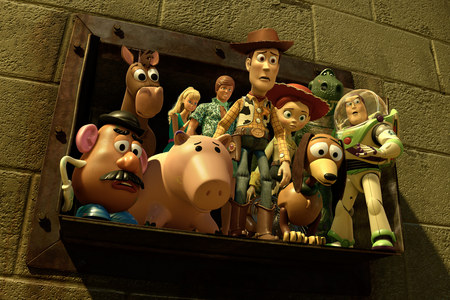
I contrast, Pixar Animation Studios does what Dreamworks cannot (at least consistently) do: entertain both the parents and children. Even young adults enjoy these films. Remembering back when I went to see Toy Story 3, the absolutely packed cinema was, I'm fairly sure, filled more with teenagers around 17-18 than any other age group. Regardless of whether it was due to the fact we all grew up with the Toy Story franchise, or they simply wanted a film to watch, the response was the same. It was universally beloved and currently ranks as the highest-grossing animated film of all time.

But the feeling of childishness does grab hold of you. You think that maybe you're a little too old for kiddie cartoon films, maybe you should start growing up and watch Oscar-baity films filled with "real" issues and "real" actors and professional acting. Embrace all that culture and independence of mind, maan. No time for jokes. Films are serious business.
But, really? Can't computer animation be serious too?

Disney Pixar's Up is, what I would regard as, one of the most important animated features Pixar has ever released. SPOILERS AHEAD. ABANDON ALL HOPE.
Up tells the story of 79-year-old Carl Fredricksen, a recently widowed elderly, and Wilderness Explorer boy scout Russell, who fly to South America in a floating house lifted by... many, many balloons. This, unfortunately, says everything that's needed to be said for older audiences. The realism isn't exactly the film's major selling point, it never has been. And true, the design of Up is utterly gorgeous. The balloon lift-off scene is perfect example of the beauty of computer animation.

But I don't wish to gush about how pretty the animation is- its a no-brainer.
No, what truly impressed me about Up is the effect of said animation. Its not just pretty, there's a remarkable skill behind the development of the characters within. Though stylized, the characters of Up are still human, and I mean that in every sense of the word: these characters are human. They're believable, their situations relatable and the emotions the animation team has made them convey beats even the most skilled and professional actors.
Whether you've heard about the opening montage of Up, which has even the most hardened of critics and movie-goers sobbing into their popcorn, or the "Stuff We Did" scene (my personal favourite, the animation of Carl's facial emotion is superb and heart-breaking), both scenes are done so brilliantly, that you'd be forgiven for forgetting its supposed to be for kids. I certainly didn't feel childish watching this film, especially with these scenes and their ability to grab my emotions with just a simple, animated gesture or expression that even the most heart-wrenching films cannot do to me.
The amazing thing is the most memorable scenes contain no dialogue whatsoever. This is the potential of animation: a story without the interruption of words or exposition being thrown in your face.
And I wish more animated films were like this. I'd have thought of Up as a daring and insightful tale dealing with: loneliness in old age, the loss of your life-long companion and eventually moving on to fulfill your life's ambitions. This is what Up could have been; but with the inclusion of talking dogs, hammy villains and exotic giant birds called Kevin, the realism presented in the characters and the silliness clash. The silliness wins over unfortunately and I was left with a sense of "what could have been..."

But, despite this, Pixar hasn't got it wrong, they still made Up a child-friendly film and I'm glad they did. You have to hand it to them, not everyone has the ability to include into kids films: relatively serious, adult issues like:

Mid-Life Crisis!


Global Pollution!


Abandonment!


Death!


Oppression!


Kidnap!


Expressing wish to kidnap children and suck the life out of them!


And yet, somehow, even the most berserk and crazy protective parents can't fault the charm and tactfulness in which Pixar tells a story, making even the most daunting of subjects watchable for children. Even enjoyable. Animation is very effective storytelling and has the potential for more than family fun.

Friday, 4 November 2011

Friends with Benefits


And so we get to our typical rom-coms of the year. The sickeningly beautiful actors all coming together to reflect upon how viewers aren't, and will never be, as perfect as they are.
All they have to do is deal with hilariously unfortunate implications, a few misunderstandings and every so often a comical scene showing their "quirky and clumsy" side... showing them fall over. How very original.

At least with the most recent rom-com Friends with Benefits, we see a slightly postmodern twist on the rom-com genre. Characters fully aware of the rom-com formula, you say? Trying to steer clear of the clichés, I hear? This isn't your traditional love story?
.... how original.

Well, it would be. If a certain "lets be friends but bone each other with no emotional attachment" plot hadn't already been done months beforehand and starred another certain female lead from another certain Oscar-nominated film about another certain crazy ballerina.

Yes, this film was very clearly the counterpart to No Strings Attached. They're called: Dueling
movies. Similar actors, similar ideas, coming out at similar time. You'll see it a lot with Dreamworks films vs. Pixar films or lately with Marvel films vs. DC films now The Avengers along with their origin stories are having the Hollywood makeover. You always see it, even if you aren't always aware, its there staring you right in the face: Haven't I seen this movie before? Only with slight differences?

There's no denying that both Portman and Kunis deserve a break after the physically demanding roles they played in Black Swan, I just didn't realize their breaks would be so parallel to each other. I'm talking same airline, same country, same hotel, suites next door to each other and at the same restaurant that night kind of similar. But which one had the better break?

Portman, after Black Swan, starred in two comedy films: Your Highness and No Strings Attached.
Your Highness was met with some pretty negative reviews, and for a comedy film, it hadn't made me laugh as much as it should have. Portman plays a relatively minor role in the film, and is not an integral part to the plot. She merely serves as a distraction, an obstacle and an eventual love interest... and there's a scene with her in a thong.
No Strings Attached was, once again, met with some bad reviews and I can't say I disagree. For a rom-com it seems a little awkward to watch and there is sadly no chemistry to be seen between Portman and Kutcher.

In contrast to two mediocre "comedy" films that star Portman, Kunis stars in a single good one. Friends with Benefits is the story of two friends, Jamie (Mila Kunis) and Dylan (Justin Timberlake) with, you guessed it, benefits!

Yes, we already know where this'll end up- its a rom-com and they -SPOILEEERS!!havetogettogetherintheendSPOILEEERS-!!

But lets be honest, its the inevitability of every rom-com. The genre isn't there to be subverted or challenged, its there as a formula for the typical love story. Two people fall in love, problems ensue, are overcome, they live happily ever after. The story may be told with a different take, the problems may be different, the setting and time may have changed, but the ending is always the same: if two people really love each other, they will end up together before the credits roll. The only film I've seen that doesn't end with such an ending is He's Just Not That Into You,
where Jennifer Connelly's character ends up divorcing her husband, and everyone in that part of the story doesn't have a happy ending- more of a bittersweet one for Connelly herself.

The pace of Friends with Benefits is fast and non-stop, something you don't usually see in a rom-com, but in this case it seemed to work quite well with the story. The fast-paced lifestyle and careers of both the main characters (one of who, can easily transfer jobs from L.A. to New York and back again as if its nothing) suits the way the story is told to viewers. Things start to slow down by the second act, paying more attention to the rom instead of the com.

One thing that surprised me about this film is the casting of Justin Timberlake. When he began acting in Shrek 3, I honestly thought it was because of his relationship with Cameron Diaz that got him the part, and he was just another big name in music trying to get into acting- but with no real acting talent.
In The Social Network, he pops up again as one of the main characters. Good acting, but not enough to really remember him for his acting- just that he was in the film.
And suddenly, whilst watching this film, his acting seems more noticeable. He's wasn't trying too hard (at least it seemed that way) and the chemistry between Timberlake and Kunis was fun to watch.

There was one thing that disappointed me though.
Throughout the film, there are certain jokes made at the expense of the Romantic Comedy genre itself, scenes where the two are watching a typical rom-com and they talk about how typical it really is. Its clever for a rom-com, but by the end of the film, the entire story falls victim to the usual formula, and the end scene was too obvious. I'd expected the self-reflective element of this film to carry on right through to the end, but I'd hoped for too much.


Friday, 29 July 2011

"All About Eve" & "Annie Hall"

All About Eve:

Interesting story about the life of theatre actresses. Its presented like an actual theatre play, which is prominent in older films anyway, but this can make the film go a lot slower than it actually needs to be. The writing is very good, a tad dated and tends to draw out a bit, but good nonetheless.

I especially enjoyed Anne Baxter's performance as Eve Harrington, as she gradually becomes more and more manipulative as her career takes off. However, even at the beginning of the film as she acts out as an adoring fan of an established but ageing theatre actress Margo Cunning, Eve's fanatical devotion to her put me on edge, especially the sweet, innocent, naive look Baxter's performance embodies, and later discards for a more husky-voiced, seductive manipulator in order to snatch Margo's parts away.

One little point that slightly agitated me and almost gave away the entire plot was the constant praise for Eve. The amount of times I heard "I like that girl!" or "Let me tell ya somethin' about Eve"... everyone was almost too nice to her and she was sickeningly modest about everything. Eve was bordering very close to the "Mary Sue" character, but it still made for a good character.

Rating: 6/10

Annie Hall:

I'm not entirely sure what to make of this film. I enjoyed it, but wasn't drawn into the story as much as I probably should have been. I didn't feel much compassion or understanding towards Alvy or Annie, but I was intrigued by their on/off relationship. Its definitely not the typical romantic-comedy, and because of this, its a classic in its own right.
I loved how every so often Alvy broke the fourth wall and how he and Annie and any other main characters spoke to complete strangers about their life or what was happening in the plot. Its a very good device to use, but was the only thing that helped me pay attention and know what the characters were feeling.

This film absolutely screams 70's. The fashions, the prominent issue of drugs, some of the lines... if nothing else, this film could definitely be nostalgic for anyone who grew up in the 70's. The dialogue in this film relies heavily on improvisation, it doesn't seem scripted at all, which adds to it realism.

I thought Woody Allen wanted very much for the audience to relate to the character he plays and the story of his relationship. Though I didn't relate, I still found the film entertaining, albeit in a weird, experimental way.

Rating: 7/10

Tuesday, 19 July 2011

Terrifying Video Games: BioShock


To begin with, I start with something that has always been an interesting topic of conversation among myself and my peers: Horror.

Or Horror Video Games so to speak.

The reason this has always been so interesting is due to the fact that everyone's perception of horror is different from one another. That said, I begin with a game that is truly terrifying to me.

BioShock is, as described by the official website: a "Genetically-Enhanced, First-Person Shooter" but with elements of Survival Horror added. A lot of people would argue (including a majority of my friends) that the Survival Horror element wasn't very prominent, therefore the game itself isn't considered scary. However, in my opinion, BioShock should be considered as one of the scariest games ever.

I'm not kidding- it gave me nightmares for months.
I couldn't sleep because I thought a doctor splicer was standing over my bed, ready to mutilate me.

But maybe its just me... your mileage may vary on this one.

I decided today to try to overcome this fear and begin playing BioShock in broad daylight with my boyfriend. I figured I should try and do what my friends did- brutally kill any splicers I see so they become mooks to me. They can be killed easily and I can easily do it with just a wrench. They cannot harm me. I AM A RUTHLESS KILLIN' MACHIIINEEE.

It didn't work.

Though I tried, and managed to kill a few splicers- I could barely play about 30 minutes of it. My boyfriend was proud of me for trying, but I still felt it was necessary to explain further why it was so scary to me... but more to try and figure out why.

For a start, the setting of BioShock is a terrifying one. Trapped in a secret underwater city and continually hunted by mutilated and deranged beings... the atmosphere is intense and this tension stays with me throughout the game (whether I'm playing or someone else is) and the emergent gameplay keeps you on your toes. Most of the scares are scripted, but there's always a surprise waiting for you depending on how you play the game.

Its also the claustrophobia. You're at the bottom of the Atlantic Ocean. Of course, Rapture is a pretty big city, but its still unfamiliar ground. Like Dead Space, most of the fear can stem from being confined, but on Earth, we know the safest places to escape to. During a zombie apocalypse, I'd know how to escape from my house and where to hide. I find myself crazy prepared just in case anything does go wrong, and I feel assured because of it.
Even the upcoming BioShock Infinite doesn't look as frightening as its predecessors, the airborne city doesn't look half as creepy as Rapture. The wide open spaces, the brightness and the "floating dreamily among the clouds" feeling the setting embodies is almost liberating, and stands as a stark contrast to Rapture, and almost fully removes that fear which I found so compelling in the first two games.

And then there's the use of sound. I've listened to a few of the splicer dialogues... its disturbing as all hell. Here are a few:

Waders (creepy "Jesus Loves Me" rendition.)

While this is immensely disturbing, this also serves as an impressive plot device, with there being a minimal amount of cutscenes within this game but with such a in-depth, extensive plot to tell the player. You pick up many audio tapes as you explore Rapture, with some being informative to the player and some just downright disturbing (one such incident as to why you find two corpses embraced with a bottle of pills next to their bed...)

BioShock has been awarded for several "Game of the Year" awards, and I can't say I disagree. The amount of thought and effort that went into this game deserves recognition and respect, and although the game's survival horror element wasn't the main intention, it succeeded in frightening most people, as well as being a visually dynamic art form and an enjoyable video game experience, albeit a very scary one for me.

"Welcoooome to the Circuuus of VAAALUUUUEEE!!"

Welcome to my blog.

My name is Mollie, and I'm gonna try my hand at writing a blog about whatever peaks my interest.

I'm a bit of a film geek, an artist and a gamer. But there may be some entries concerning different subjects as well.